
Floating and Submerged Structures#
What is inside this book?#
Welcome to this open, interactive book on Floating and Submerged Structures. This book will guide you through the fundamental topics needed for the design and analysis of floating and submerged structures. From the evaluation of future needs and characterization of environmental conditions, to the detailed assessment of the dynamic behaviour of floating and submerged structures with mooring systems.
The aim of this tool is to go beyond a traditional textbook, providing an interactive learning environment designed to guide you through the different steps in the design and analysis of floating and submerged structure. Here you will find:
Fundamental Theory: Core concepts in the most relevant topics such as environmental source characterization, hydrostatic and hydrodynamic loads, fluid-structure interaction fundamentals or mooring systems, among others.
Tutorials and Code: Integrated Python notebooks with step-by-step guided tutorials that you can modify and build on.
Visual Learning: Animations and interactive illustrations to help visualize relevant concepts such as structural responses and different hydrodynamic effects.
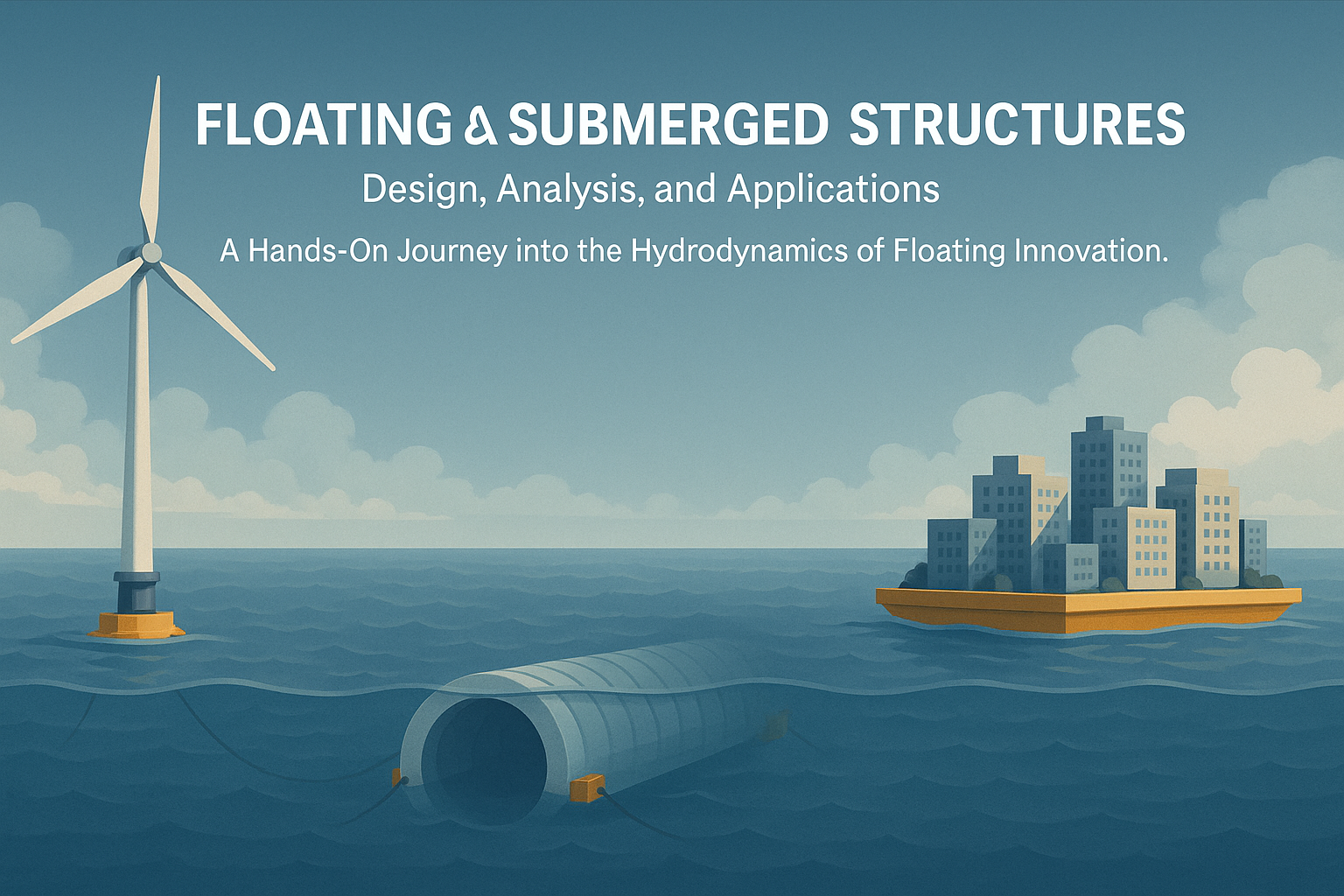
Case Studies: Whenever possible, we link to real-world examples such as submerged tunnels in Norway, floating wind farms in the North Sea, and futuristic concepts like ocean cities.
Who is this book for?#
This resource is an integral part of the module on Floating and Submerged Structures from the Hydraulic and Offshore Structures (HOS) track, offered within the Master in Civil Engineering program at Delft University of Technology (TU Delft). The content not only serves this course but is also shared across other modules within the Civil Engineering and Geosciences master — and even extends into related programs such as Renewable Energies and Floating Wind in the Aerospace faculty.
This book is also open to a wide audience accross academia and industry. Whether you are a student, researcher, or practicing engineer, this resource aims at helping you in understanding the fundamentals and application-oriented knowledge required for the design and analysis of floating and submerged structures.
Table of contents#
This online book is structured as a Jupyter Book and is organized into the following main chapters:
Fundamentals. Introduction to Floating and Submerged Structures and introduction to basic concepts that influence their design and analysis.
Environmental Source Characterization. Identification and quantification of environmental forces, such as waves, wind, and currents, that govern the design and analysis of floating and submerged structures.
Loads on Floating and Submerged Structures. Definition and characterization of environmental and operational forces that act on floating and submerged structures and govern their stability and dynamic response.
Design Principles. Definition of the principles used to design a floating and submerged structure ensuring stability and structural integrity, among others, under varying environmental conditions and operational loads.
Mooring Systems. Definitions, design and analysis of mooring systems including various concepts, line types, materials and configurations.
Modeling and Analysis of Floating and Submerged Structures. Definition of the key modeling strategies for floating and submerged structures, covering how design principles are translated into mathematical and computational models for simulation, analysis, and performance prediction.
Experimental Techniques in FSS. Description of how physical model testing in wave tanks or basins can be used to evaluate hydrodynamic behavior, validate numerical models, and support design development under controlled conditions.
Stakeholders. Description of different stakeholders that can play a role in the design of floating and submerged structures, with assessment of their interests and influence.
Advanced topics. Definition of various advanced topics such as nonlinear effects or coupled hydro-elastic response of floating structures, which require a more in-depth analysis that is not covered in detail in previous chapters.
Acknowledgements#
This book builds on the rich tradition of computational mechanics education and research at the Faculty of Civil Engineering and Geosciences at TU Delft. We extend our gratitude to all who have contributed to and supported this ongoing endeavor in advancing the study of floating and submerged structures.
References#
The references for this book are available in the references.bib file.